Post-mortem

SideDish
Was AI notes for booths a tar-pit idea?


Intro
I’ve built Gong for conference booths, and it failed.
The short version: people loved the idea, but nobody had a real reason to change their behavior to use it, and I think I was too early.
I am writing this mostly for myself so I can have closure but I thought that there is a slight chance someone might find this useful. I am also playing with the thought of open-sourcing the code, but I can’t imagine someone would actually need it, but who knows.
Before I jump ahead, let me introduce myself- My name is Koby Soto. I was the founder of Guesty (YC W14) which I co-founded with my twin brother. After Guesty, I had a few years of retirement, and out of boredom and passion to build, I went back to create a couple more startups- of which SideDish is what I’m writing about here.
The problem
The problem I was trying to solve is simple- You get back from a conference with a list of leads, of complete strangers, and start cold emailing or cold calling them from scratch. This is plain stupid because with most of them you or your team had meaningful conversations with plenty of information to jumpstart your relationship. Human brains are just not built for remembering large amounts of conversations, especially not with strangers, and especially not the repetitive kind- the one you do over and over again. You ask your team to take notes, but in reality they don’t. Those who do write one sentence, or up to 4 keywords to try to sum up the conversation. This is either because it’s hard to summarize a conversation, or they don’t remember what was said, or they just don’t have time to do it, or they need a break. Usually it is all of the above.
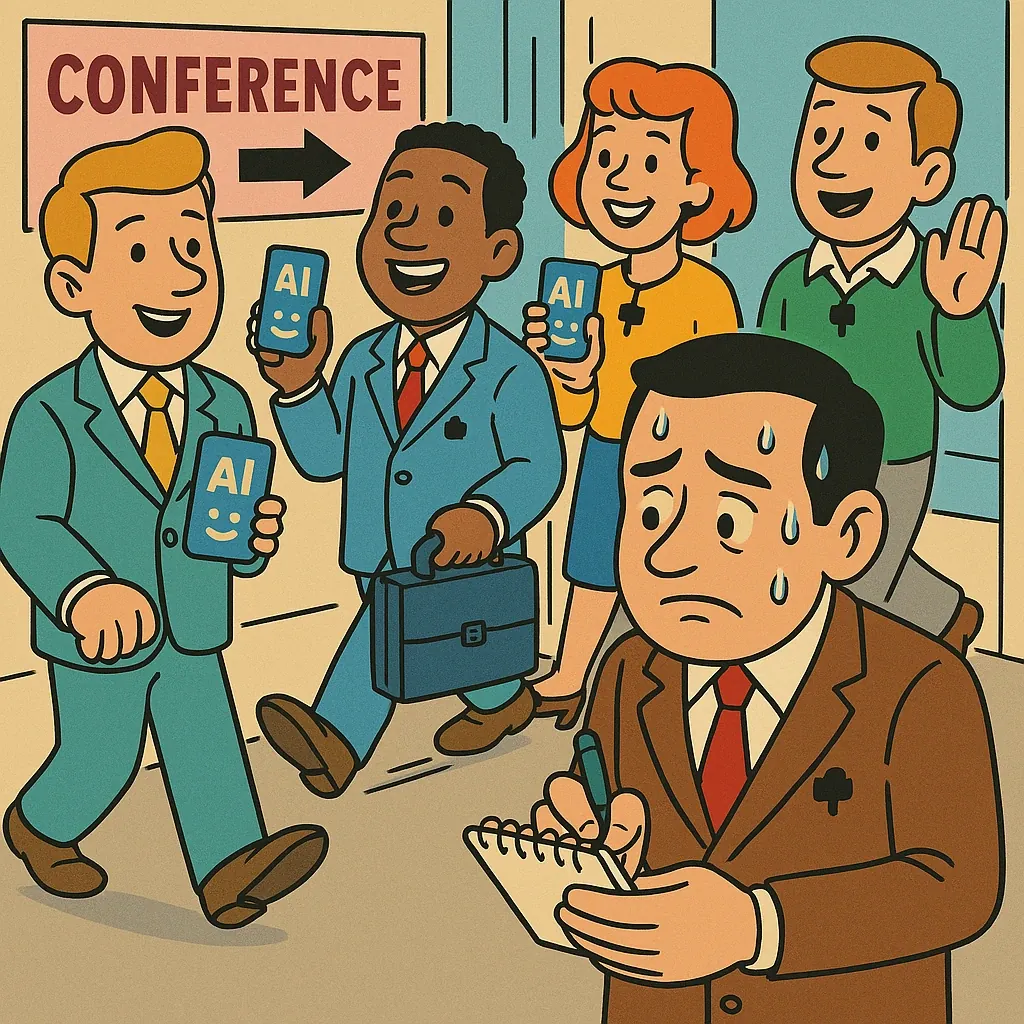
This is extremely upsetting when you take into account how much money is invested in events like that. The booth costs, the production, flying a team there, the hotels, the swag, not to mention the team alternative costs. Huge.
Imagine if you had the full conversation, the emails you send after the conference could be actually personalized, the calls could continue from where they were left off. This is rocket fuel for a sales team. I attended so many conferences in the last few months that I am always amused by the imposter personal emails, those that are obviously generic but are trying to come off as if they are personalized and they remember what we talked about when it is clear they don’t.
Later I tweaked the problem and tried multiple narratives and selling points- Get visibility to the actual conversations your team have in events; Have your entire team participate in events while sending just a few; Monitor brand and make sure team is on brand; Get product feedback from events, and many more…
And this was my personal problem as well. I’d always go to conferences, even back in Guesty days, and collect business cards and then write a few words on them. Later in the hotel room I’d upload them to the CRM, sometimes baffled and scrambled to remember what I mean…
So I sat down to solve it, and not just to solve it, I fell in love with it, which is a mistake a founder should never make. It prevents you from keeping your checks and balances in place. I was my own user so of course it is good.
The product
When people hear about this idea, they immediately think of all the dozens of note taking AI apps out there, and they are right - there are so many, including Gong themselves. But lead capturing at events is very different. It isn’t a scheduled meeting with someone you know. It’s a random unscheduled quick meeting with a stranger and the goal is to capture a lead, not to discuss things in length. It’s more like speed dating. I thought there is enough differentiation here to work with. I still do. Competition isn’t the reason SideDish didn’t work out.
I’ve built a mobile app, with React Native. Of course I used Cursor but I was also very surprised how not great the code it gave me was. Thankfully I have 20 years of coding experience so I knew what I was doing and what needed to be done. You’d create an event and then you had a button to start recording, a button to scan a badge, and a button to manually add a lead. The flow order didn’t matter, you could start a recording and then scan a badge, or you can scan first and then hit record.
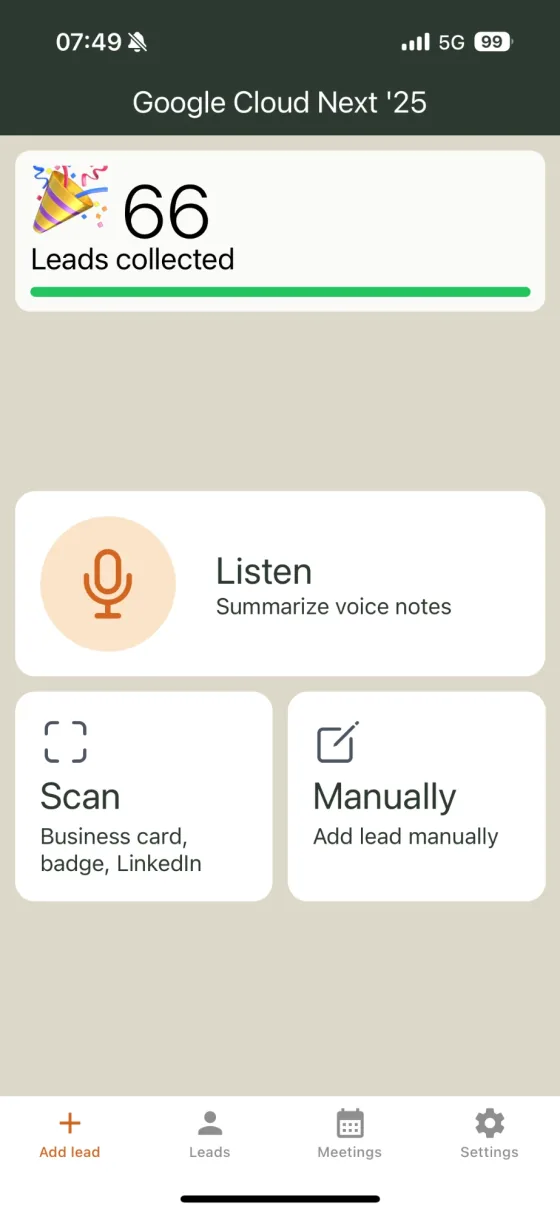
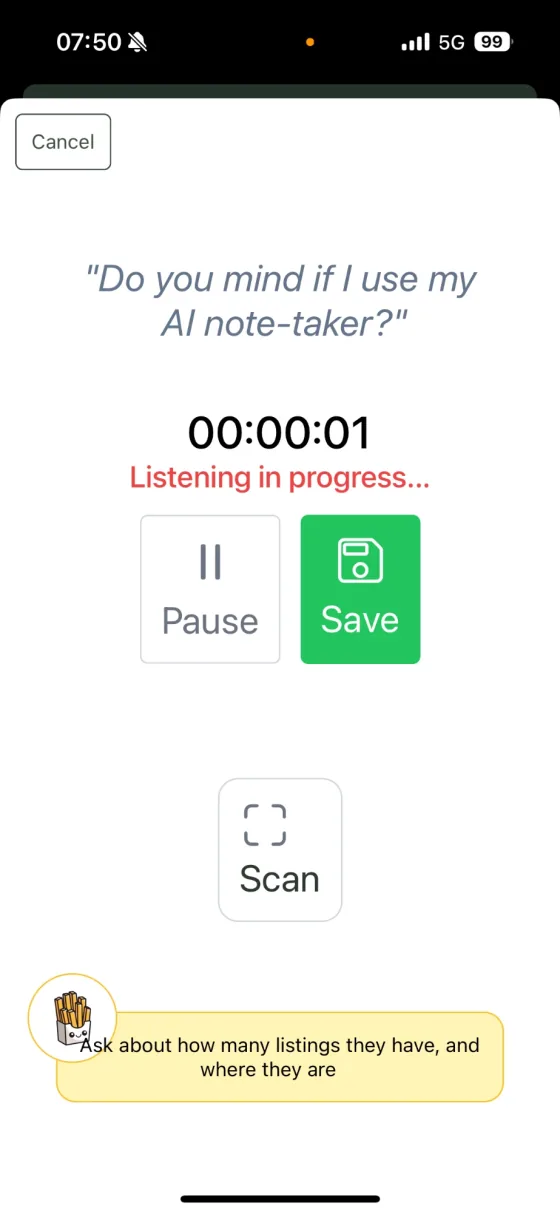
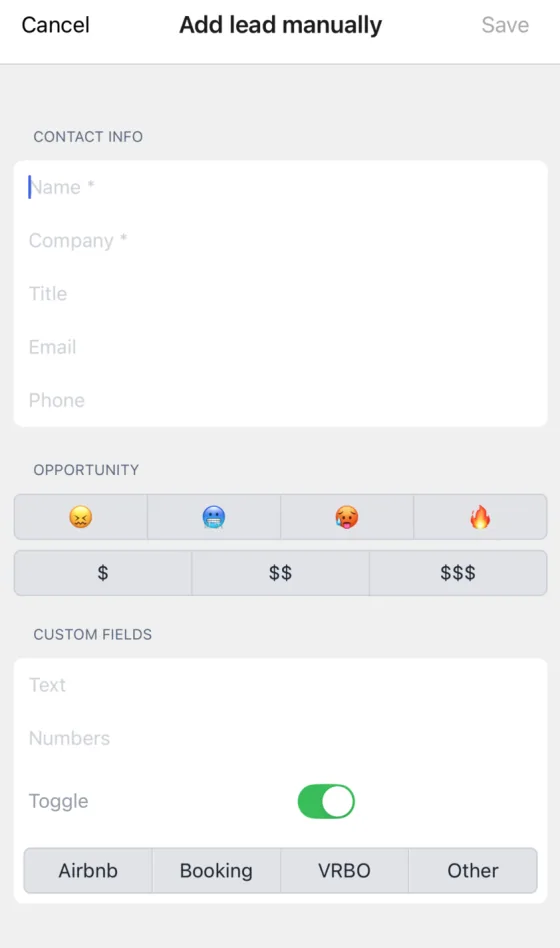
My solution required people to start and stop a recording because I thought people would prefer that and find it less creepy (more on privacy in a bit), and because it is incredibly less challenging technically to decide when speakers change and a conversation restarts, especially without a camera. I also required them to take a picture of a badge to know who they were talking to, so it didn’t seem like a lot to also make them hit “record” (this turned out to be a mistake).
The engineering part wasn’t super easy. Online meeting tools such as Zoom are far easier to record. These are often in very quiet spaces, and each participant has its own audio channel. I had to use one audio channel for all participants in a very loud environment. Sometimes the recorded audio was so bad that to a person it would be unusable. To my surprise most speech to text AI models would give a surprisingly good result. Not great but a good start. When being asked about the performance, I used to answer that 60% is better than 0%. The identification of speakers into separate tracks (Diarization) was much worse, outputting very inaccurate results. I slowly improved the performance week by week, by adding more layers. In the end I used multiple speech to text models in parallel with some domain tweaking and brand recognition, then used a mitigation model that would feed information about the product, the company and the salesperson. That led to substantially better results.
The elephant in the room, and the number one question I’d get is “what about privacy?” or “Do I have to ask for permission?” and it’s a valid question (even though I personally don’t really believe in privacy nowadays) and I’m not a lawyer, but personally I think the answer is that conferences are a public space and that there is no expectation of privacy in a conference and an expo floor. Anyone can eavesdrop. I usually suggested mentioning it as a courtesy, and personally I always did, and I used it to draw attention to it. I even included a catch phrase in the app screen- “Do you mind if I use my AI note taker?”. There used to be a time when recording your business conversations must have been weird or creepy but nowadays I believe 100% of your sales conversations are recorded and everyone is using Gong or any of the competing alternatives. Although this was the number one question, I don’t think it was a real issue for people. People just needed to get used to it, but I don’t think they cared. This is also not the reason why SideDish didn’t succeed.
Getting users
I remembered that back in the early days of Guesty, when we tried to find Airbnb hosts, we would go to Dolores park in San Francisco holding a sign “Are you hosting on Airbnb?” and then started asking random people if they are. That got us initial traction. So I decided to go on a similar guerrilla marketing idea- I’m looking for people who work in booths in conferences, and where would I find them? In conferences obviously. So I bought a ticket to a few conferences, where I anticipated there are plenty of booths. Then I’d go in the slower hours to not interrupt the work they are there to do, and try to talk to them about how they collect leads and whether they keep notes. The answers were spot on, as I expected, and the conversations went great. I’ve collected tens of leads, used my app on the floor myself. A part of the pitch was to show them I am using it at that moment and to give them a demo. These all went great. Then when I went back to the office, I would articulate personalized emails with the context of the actual conversation that I had with them. Heck I even included a link to it… And then I waited... Despite the enthusiasm of most, these converted into very few meetings and even fewer sales.
I did that in several conferences, big and small, without better results.
I then decided to buy wireless mics, the good ones, and give them as a gift to people who were excited about the product and wanted to use it. I would make them sign up on the spot for a free trial, give them a free mic, and show them how to use it. Handed about 50 mics, perhaps more, some used it, some just went silent.
Some sales did happen, which was a driver to keep going, but these too barely used the app. On several occasions it was a manager that I sold to, that loved the idea and wanted it, but couldn’t make his team actually use it. I either refunded them or gave them more credits to try in another conference. They just didn’t push “record”. A few used it in 5-10, the majority used it for 3-4 conversations a day, a mere fraction of the conversations they actually did.
In total blindness to the results, I kept building more and more features. I added functionality to schedule meetings during an event. I added custom fields. I added team synchronization in real time. I added web dashboards so that a team leader can sit in their office and listen to the conversations in real time. I added a search. I added enrichment. I added fast QR scanning. I added leaderboards. Great features that no one cared about.
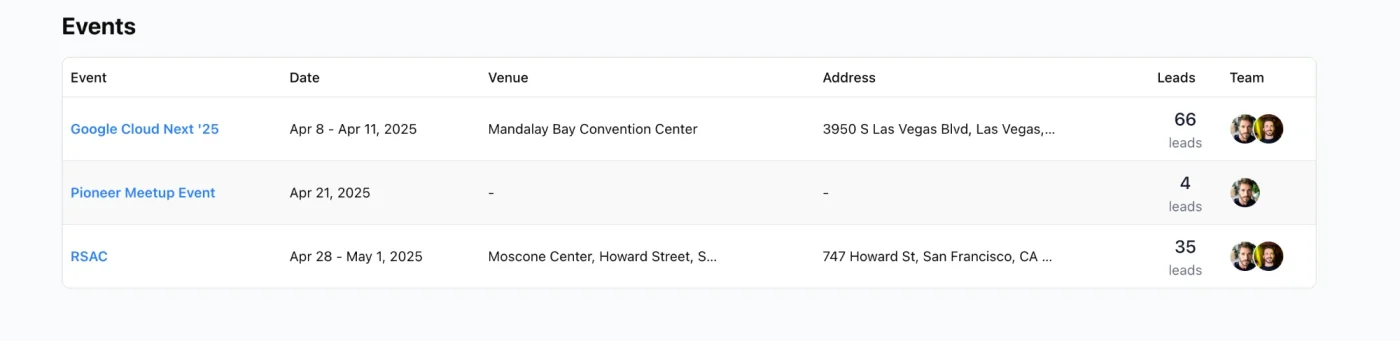
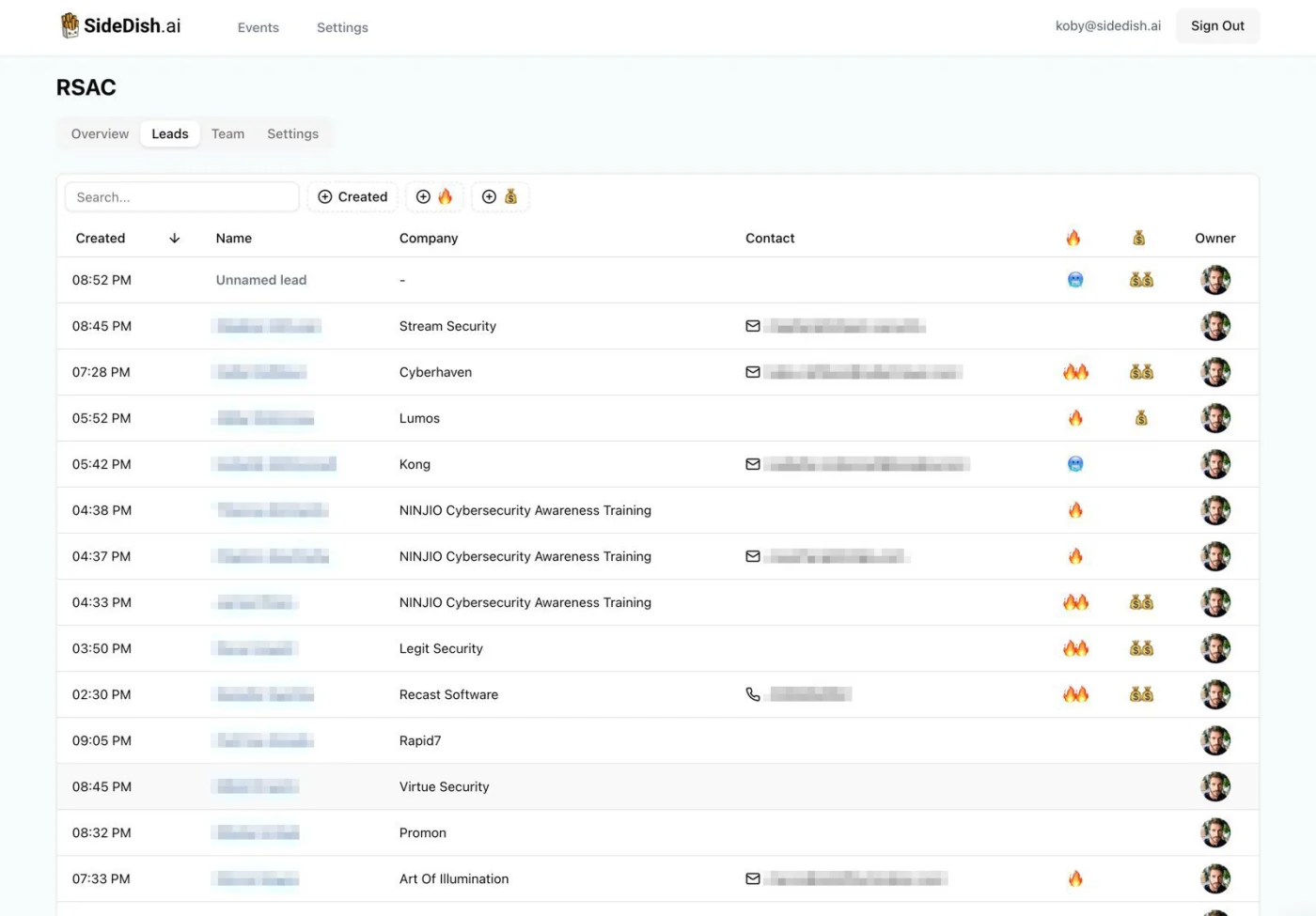
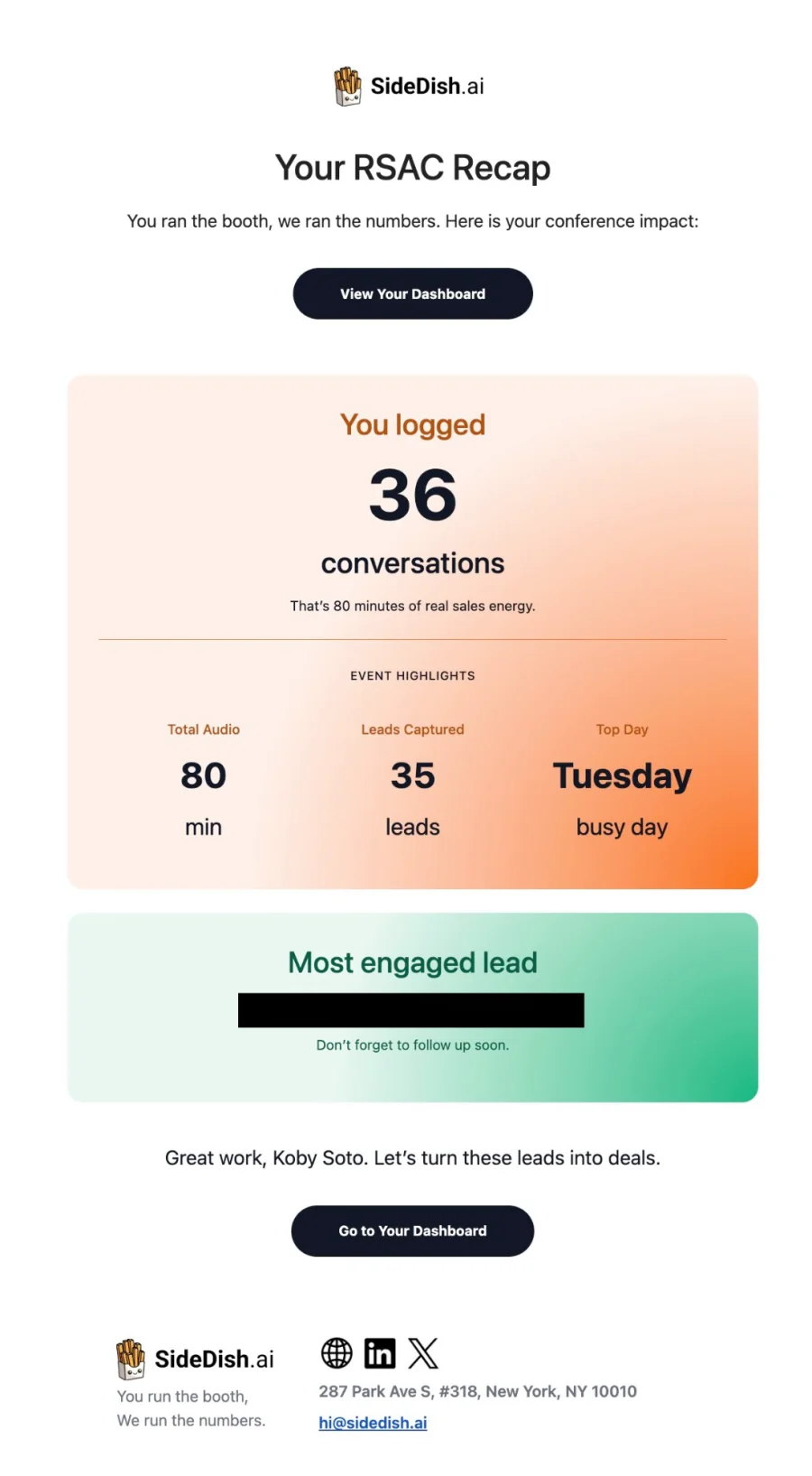
One thing I regret in retrospect is that I never launched the product. I would sell it in person, but I didn’t launch it. Not on ProductHunt or any other platform. I don’t know why. Frankly I think I was afraid of being ridiculed and to the other extreme - copied.
Why it failed
Making people change their behavior is very very hard. What made Gong and the online meeting recorders work is that they required no action or change of behavior from their users, as they would automatically join the meeting and work in the background. But I couldn’t. A person would have to wear a mic (or hold their phone, or put it on a table) and press “start” and then “save” as well as “scan a badge” and apparently that was a lot to ask, even if that was their job, and the entire reason of them being there.
I came to realize that no one on the team is being measured on the notes they take or don’t take. No one is getting fired or promoted based on that. There is no incentive for people to change their behavior. Perhaps they care, but not that much. I found that the people that cared the most were excellent salespeople who knew that they would be in charge of the follow up. Unfortunately they were rare. People just didn’t use it. This was the main reason why SideDish has failed.
So I tried to minimize friction, I even considered recording constantly. It would be complex engineering but could be done, but I don’t think it would have mattered. In all solutions I contemplated, there would be at least some friction, and I needed people to care.
Another reason was the tension or conflict with the already existent lead scanners. There was a unanimous disdain for these. No one liked them. They were poorly designed, stopped working constantly, cost a lot, and had minimal functionality. But they had the data. Conferences would sell it to booths or include it in the exhibitor package so that providers would be locked in. My solution would cost them a fraction, would work flawlessly and have AI notes and summary functionality included but they wouldn’t want to give up on the actual contact details the official lead scanner device would give them. Our lead scanning functionality would grab the details from the badge, then use enrichment tools to get the contact details, so the result was comparable in most cases, but that wasn’t enough for almost none of the companies I talked to. They paid for the real data, so they won’t give up on it. What it meant was that using our product would complicate the process and require scanning the lead in two devices. Another change in behavior and a quirky one I must admit.
Working with conferences wasn’t a good solution either. Most conferences are tied in multi-year contracts with a provider that gives them solutions for their entire stack, including ticket sales, backend management and such, and this is just an add-on they provide. Other conferences aren’t tied but chose a provider that pays them in advance. I heard prices in the $30K-50K range and above just to offer that to their exhibitors.
I tried hacking this but it requires a case by case scenario (some easier than others) which even when possible and aside from legal questions, I couldn’t commit to our clients that we could do in every conference.
Last words
Every time I pitched this product, people were excited. They related to the problem.
But their empathy didn’t translate into personal pain.
For most, it was a nice to have—something they’d use if they remembered.
YC’s tagline is the infamous: “Make something people want.”
This wasn’t something people wanted. Sure, they’d love to have a perfect recall of every conversation. But love to have isn’t want.
Personally, I’d still use it. I love it. It’s hard to go back to not remembering anything.
So, was it a tar-pit idea? No, I don’t think so, but I do think it might have been too early.
Despite my failed attempt, I believe this problem will be solved in the future.
There are already hardware attempts to record your entire day—Limitless, Plaud, Bee. OpenAI is rumored to release something, and Google demoed glasses on stage.
I suspect the future will be full of devices that record everything. When that happens, conferences will have apps that utilize them.
Thanks for sticking to the end of this. I tried to be open about the path I took.
What’s next? I’m back to the drawing board.